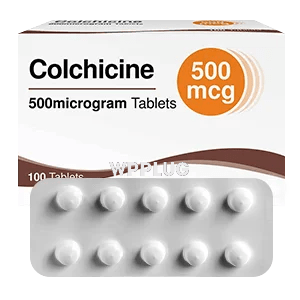
| Product dosage: 0.5mg | |||
|---|---|---|---|
| Package (num) | Per pill | Price | Buy |
| 60 | $0.96 | $57.34 (0%) | 🛒 Add to cart |
| 90 | $0.79 | $86.01 $71.43 (17%) | 🛒 Add to cart |
| 120 | $0.70 | $114.68 $84.50 (26%) | 🛒 Add to cart |
| 180 | $0.63 | $172.03 $112.67 (35%) | 🛒 Add to cart |
| 270 | $0.57 | $258.04 $152.91 (41%) | 🛒 Add to cart |
| 360 | $0.54
Best per pill | $344.05 $194.16 (44%) | 🛒 Add to cart |
Synonyms | |||
More info:
colchicine
Colchicine is a plant-derived alkaloid medication originally extracted from the autumn crocus (Colchicum autumnale). It’s one of the oldest known medicines still in clinical use today, with references dating back to ancient Egyptian times. What’s fascinating about colchicine is how this ancient remedy has found completely new life in modern cardiology. While it remains the gold standard for treating acute gout flares and familial Mediterranean fever, the real excitement in the medical community has been around its cardiovascular applications.
allopurinol
Allopurinol is a xanthine oxidase inhibitor, a medication primarily used to manage chronic hyperuricemia and prevent gout flares and uric acid nephrolithiasis. It’s not a dietary supplement or medical device but a prescription drug with a well-established role in clinical practice. This monograph will detail its composition, mechanism, clinical use, and evidence base, adhering to a structured, evidence-based format. 1. Introduction: What is Allopurinol? Its Role in Modern Medicine Allopurinol is a purine analogue that inhibits xanthine oxidase, the enzyme responsible for converting hypoxanthine to xanthine and xanthine to uric acid.
benemid
Probenecid, a uricosuric agent first approved by the FDA in 1951, remains one of those fascinating drugs that keeps finding new relevance decades after its initial introduction. Originally developed to prolong penicillin levels by reducing renal excretion, we discovered almost by accident that it significantly increases uric acid excretion - which completely changed its clinical trajectory. I still remember my first rheumatology rotation where the attending physician called it “the grandfather of gout therapy” while showing me how it worked synergistically with penicillin in a patient with concurrent infection.
Biaxin: Effective Bacterial Infection Treatment - Evidence-Based Review
Biaxin, known generically as clarithromycin, is a macrolide antibiotic medication—not a dietary supplement or medical device—used primarily to treat various bacterial infections. It works by inhibiting bacterial protein synthesis, effectively stopping the growth of susceptible bacteria. Available by prescription in tablet and oral suspension forms, Biaxin is commonly indicated for respiratory tract infections, skin infections, and Helicobacter pylori eradication in combination therapy. Its role in modern medicine is significant due to its broad-spectrum activity and well-established efficacy in both community and hospital settings.
dapsone
Dapsone, a synthetic sulfone antimicrobial agent, has been fascinating to work with over my 25 years in dermatology and infectious disease. I remember first encountering it during my residency when we had a leprosy patient who’d failed multiple regimens - watching those skin lesions gradually improve over six months taught me more about patience in medicine than any textbook could. Dapsone: Targeted Anti-Inflammatory and Antimicrobial Action - Evidence-Based Review 1. Introduction: What is Dapsone?
feldene
Feldene, known generically as piroxicam, represents one of the older nonsteroidal anti-inflammatory drugs (NSAIDs) in the oxicam class. It’s available in oral capsules and gel formulations, though the oral form has been largely discontinued in many markets due to safety concerns. What’s fascinating about Feldene isn’t just its mechanism—it’s how this drug illustrates the evolution of our thinking about pain management and risk-benefit profiles. When it first appeared in the 1980s, we thought we had the perfect arthritis solution.
lipitor
Lipitor, known generically as atorvastatin calcium, represents one of the most widely prescribed and extensively studied HMG-CoA reductase inhibitors in modern cardiovascular pharmacotherapy. As a cornerstone of lipid management, its primary role involves significant reduction of low-density lipoprotein cholesterol (LDL-C) and stabilization of atherosclerotic plaques, fundamentally altering the trajectory of atherosclerotic cardiovascular disease (ASCVD) risk. The development journey wasn’t straightforward—our initial clinical trials team debated fiercely about the optimal dosing strategy, with some advocating for more aggressive titration while others worried about muscle-related adverse events.
naprosyn
Naprosyn, known generically as naproxen, is a nonsteroidal anti-inflammatory drug (NSAID) available both by prescription and over-the-counter in lower doses. It’s widely used for its analgesic, anti-inflammatory, and antipyretic properties, primarily for managing pain and inflammation associated with conditions like osteoarthritis, rheumatoid arthritis, and acute gout. Unlike dietary supplements, Naprosyn is a well-established pharmaceutical agent with a robust evidence base, but its accessibility means both clinicians and patients need thorough, evidence-based guidance on its proper use, risks, and benefits.
pravachol
Pravastatin sodium, the active pharmaceutical ingredient in Pravachol, represents a cornerstone in modern lipid management therapy. As an HMG-CoA reductase inhibitor, it specifically targets hepatic cholesterol synthesis, producing significant reductions in LDL-C while offering a favorable safety profile that’s made it a first-line option for decades. What’s fascinating isn’t just its mechanism—which we’ll explore in depth—but how its hydrophilic properties create a distinct clinical advantage over lipophilic statins when considering muscle-related adverse events.